Technical Characteristics of Upper Leaves (Thickness, Nicotine, Burn Rate) vs. Middle and Lower Leaves
- Introduction | Framing the question through an "abnormal burn" in a Yunnan quality lab in 2022
- Upper leaf | Thin, fast, high-nicotine — understanding the strength logic behind the lightness
- Middle/lower leaf | Steady, thick, slow-releasing — the ballast stone of tobacco quality
- Parametric comparison | One table to read the hard-core contest of thickness, nicotine, and burn rate
- Industrial application | How parameters translate into commercial value
- Expert perspective | Lessons beyond the textbooks: learning to leverage parameter fluctuations
- Conclusion | Behind the parameters lies the projection of growth strategy and environmental adaptability
Introduction: Starting from an "Abnormal Burn"
Late one night in November 2022, in the quality inspection laboratory of a tobacco processing plant in Yunnan, the air was filled with a peculiar scent blending dried grass and a faint caramel note. Rolling hills stretched beyond the windows, and the lab lights felt somewhat cold and detached. I was staring intently at a set of data from an ongoing burn-characteristic test, my brow furrowed.
That batch of tobacco leaves, fresh out of the curing barn, exhibited highly unstable behavior in standard burn tests: the burn rate was too fast, accompanied by an indescribable "scorched sensation," even though we had strictly controlled the blend ratio of the cut filler. The instrument readings were jumping, revealing an anomalous peak in the Heat Release Rate within the first 30 seconds after ignition.
Through a meticulous breakdown of this batch, I used not only routine chemical analysis but also a scanning electron microscope (SEM) for closer observation. I found that the problem did not lie in the temperature curve of the curing process, but in the selection of raw material — the share of upper leaves in this batch exceeded the preset value, and because that season saw heavier rainfall, the physiological characteristics of the upper leaves had shifted subtly.
This once again drew me into a long-standing question: between the upper leaves and the middle/lower leaves of a tobacco plant, what essential differences exist across the three core dimensions of thickness, nicotine content, and burn rate? And how do these differences, through a chain of physical and chemical reactions, ultimately determine the commercial value of tobacco products and the user experience?
I. A Technical Portrait of the Upper Leaf: A Contest of Lightness and Strength
In tobacco physiology research, we usually refer to the leaves near the top of the plant as "upper leaves." From a morphological perspective, because upper leaves grow at the very top of the plant, they receive the highest light intensity, while also facing the greatest challenge of water supply pressure.
1.1 The Microstructure of Leaf Thickness and Its Physiological Significance
A notable feature of the upper leaf is that its blade thickness is relatively thin. Under the microscope, the arrangement of its mesophyll cells presents a highly compact geometric pattern, but the cross-sectional thickness of a single cell layer is clearly smaller than that of middle and lower leaves. This thin structure does not mean the leaf is "weak"; rather, it is an extreme optimization for photosynthetic efficiency.
A thinner blade allows light to penetrate the tissue more effectively, maintaining efficient carbon fixation under intense light. However, structurally, this type of leaf is physically very fragile. Because the cell walls per unit area are thinner, its osmotic pressure regulation capacity is also relatively weaker. Under drought or high-light stress, upper leaf cells are more prone to shrinkage, which also leads to an extremely rapid rate of moisture loss during curing.
In actual curing operations, this "thinness" is an extremely sharp double-edged sword. Because of its huge surface-to-volume ratio, heat conduction is extremely fast. If the drying curve control deviates even slightly — a fluctuation of merely a few degrees — it can trigger a severe "overheating reaction" in the upper leaves, causing premature oxidation of sugars and aromatic substances inside the cells.
1.2 The Physiological Distribution and Synthesis Logic of Nicotine
Regarding the distribution of nicotine, the industry has long held multiple hypotheses, but based on my years of comprehensive data from field sampling and laboratory analysis, one pattern is clear: upper leaves tend to exhibit a higher nicotine concentration gradient.
As a defensive secondary metabolite, nicotine is synthesized mainly in the root meristem at the root tips, then transported to the leaves through the xylem. During the vigorous growth period, upper leaves act as the "outpost" for nutrients and metabolites, with extremely high physiological activity. Because the metabolism of upper leaf cells is vigorous, their efficiency in absorbing and converting nitrogen is also higher, which directly leads to a greater accumulation of endogenous nicotine compared to the "aging" middle and lower leaves.
At a deeper level, to cope with intense light and potential pest damage, upper leaves increase the synthesis of secondary metabolites by regulating their metabolic pathways. This physiological "defensive investment" objectively raises the nicotine content in the leaves.
1.3 The Physical Logic of Burn Rate: Thermal Resistance and Oxygen Permeation
The combination of thickness and nicotine density directly determines the burn rate of the upper leaf.
From a physics perspective, combustion is a process coupling heat transfer with chemical reactions. Because the upper leaf blade is thin, its thermal resistance during burning is extremely low, and oxygen permeability is extremely high. This means that at the moment of ignition, oxygen can rapidly penetrate into the leaf tissue, forming positive feedback with the heat generated by combustion, causing the combustion reaction to reach a peak in a very short time.
Combined with its higher nicotine content (nicotine itself has certain flammable characteristics), the upper leaf often displays a "fast and fierce" tendency when burning. This trait is ideal for producing high-strength, fast-paced tobacco products, but if not controlled well, it can lead to over-shooting of the smoke, producing a pungent, burnt-paper-like sensory experience.
II. Middle and Lower Leaves: The Steady Keel
Unlike the "light and aggressive" character of the upper leaves, middle and lower leaves display a "steady and substantial" vitality. They are the "ballast stone" of tobacco quality, playing an irreplaceable role in complex tobacco blends.
2.1 Structural Thickness and Mechanical Strength
Because middle and lower leaves have a longer growth cycle, they undergo a more complete process of cell division and expansion. Under the microscope, we can observe that their mesophyll cell layers are more numerous, and the cell walls have become thicker due to a higher degree of lignification. This physical thickness not only brings greater mechanical strength but also provides more space for storing water and nutrients.
The direct result of this thickness is an extremely high thermal inertia. During curing, middle and lower leaves can withstand a slower, deeper heat conduction process. This "slow-paced" dehydration process allows internal chemical reactions (such as the Maillard reaction) to proceed in a more uniform temperature environment, thereby producing more complex and richer aromatic precursors.
2.2 Nicotine and Compositional Balance: The Source of Complexity
Although the nicotine concentration of middle and lower leaves is usually lower than that of upper leaves, their stability in material composition is their core advantage. Middle and lower leaves accumulate more cellulose, pectin, and various trace elements. This complex chemical composition gives their smoke not only basic strength during burning, but also a rich "foundation" — the characteristic mellow depth of tobacco.
From a biochemical perspective, the metabolic processes of middle and lower leaves tend to be stable, and their profile of secondary metabolites is broader than that of upper leaves. This includes not only nicotine, but also a large number of terpenoid compounds and flavonoids, which together build the "baseline" of tobacco aroma during the burning process.
2.3 Slow-Paced Burn Characteristics: A Guarantee of Persistence
As the leaf thickness increases, thermal resistance grows, and the diffusion path of oxygen within the tissue also lengthens. This causes the burn rate of middle and lower leaves to be relatively slow and steady.
This slow burning process allows the various volatile components in the tobacco (such as aroma substances) to be released gradually over a long period, rather than bursting out in an instant and quickly disappearing like the upper leaf. This "long-tail effect" is crucial for maintaining the persistence and consistency of the smoke during the smoking experience, and it is also the key factor that determines whether a product has a "sense of depth."
III. Parametric Comparison: A Hard-Core Contest of Core Dimensions
To understand the differences between the two more intuitively, we can conduct a parametric cross-comparison through the table below (the following data are based on the mean values of experimental observations of a typical variety under specific climatic conditions):
| Technical Parameter | Upper Leaf | Lower Leaf | Influencing Mechanism |
|---|---|---|---|
| Average Thickness (µm) | 150 - 220 | 300 - 450 | Determines heat conduction rate and mechanical strength |
| Nicotine Content (%) | 3.5% - 5.2% | 2.0% - 3.5% | Determines the strength and "impact" of the smoke |
| Burn Rate (rel.) | High (1.4x - 1.6x) | Low (0.8x - 1.0x) | Jointly influenced by thickness and oxygen content |
| Cell Wall Lignification | Lower | Higher | Affects smoke stability and residue |
| Moisture Retention Capacity | Poorer | Stronger | Affects the tolerance of the curing process |
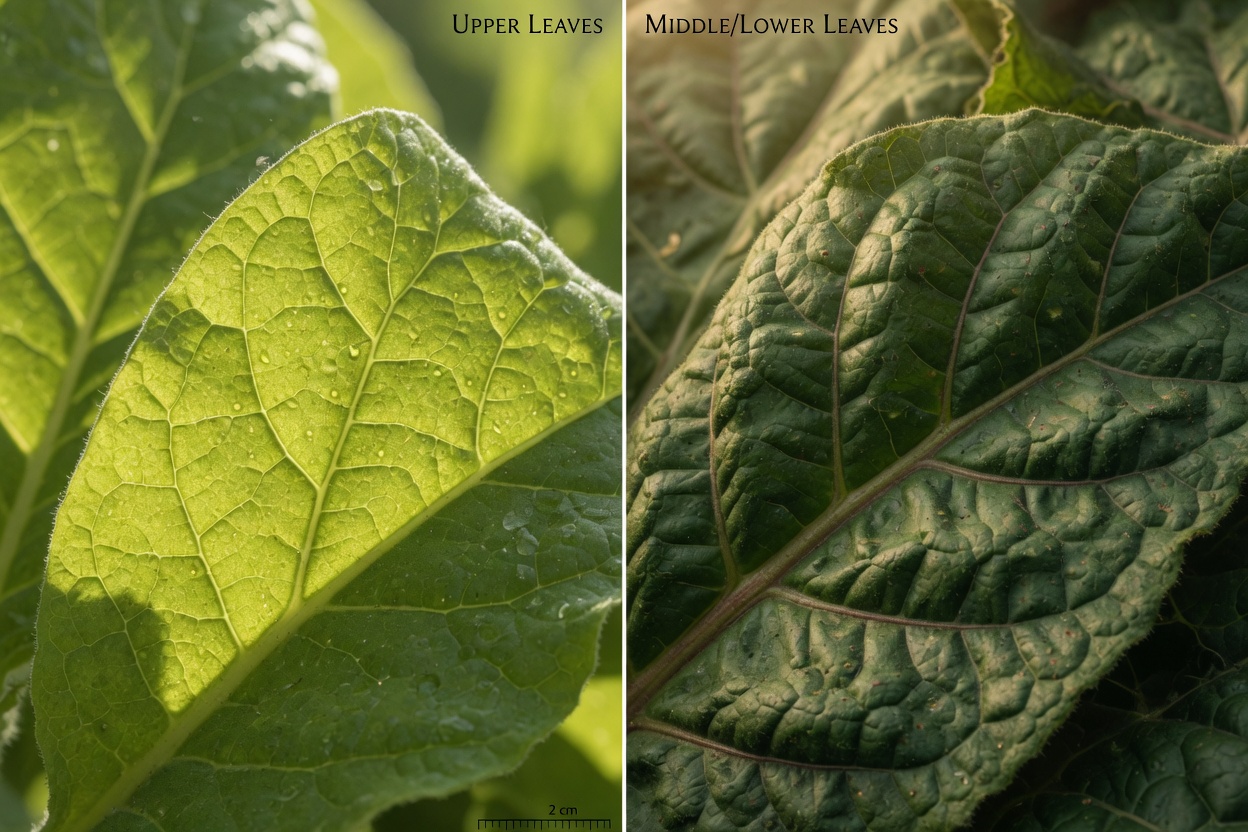
Upper leaf
Strong impact, fast burn — suited to products pursuing high intensity and a fast-paced feel
Middle/lower leaf
Steady and substantial, slow-releasing — defining the mellow depth and persistence of the smoke
From the data, it is clearly visible that upper leaves hold the advantage in "strength" and "speed," while middle and lower leaves excel in "stability" and "thickness." This difference is not a simple superiority or inferiority, but a physiological functional differentiation.
IV. Industrial Applications: How Parameters Translate into Commercial Value
In actual tobacco blend design, we are not simply looking for the "best leaf" but searching for the "most suitable balance."
4.1 Upper Leaves: The "Power Source" of Premium Products
For high-end cigarette products that pursue high impact and a fast-paced feel, upper leaves are indispensable. Their high nicotine content can quickly establish the "skeleton" of the tobacco, letting the smoker feel the product's character at the first puff. At the same time, their faster burn rate helps create a light, brisk smoking experience without dragging.
However, if the proportion of upper leaves in the blend is too high, the product may develop a "hollow feeling" — that is, although the nicotine impact is strong, the aroma components are released too quickly, causing the smoke to become thin and dry in the later stage of smoking. This is a common technical pitfall in the development of certain "light and brisk" products aimed at the young market.
4.2 Middle and Lower Leaves: The "Ballast" of Smoke Quality
Middle and lower leaves are the "ballast" of smoke quality. The substantial feel and slowly released aroma components they provide can effectively fill the impact gap left by the upper leaves, making the smoke round and mellow. When designing products for large-diameter or long-duration smoking, the proportion of middle and lower leaves is usually significantly increased to ensure the persistence and consistency of the smoke during the entire smoking session.
In the development of e-cigarette tobacco base, the balance of cellulose and sugars in middle and lower leaves is also particularly critical, because it directly affects the physical stability of the base material and its chemical stability during the heating process.
V. Deep Insight from an Expert Perspective: Lessons Beyond the Textbooks
Over years of practice, I have come to a core conclusion: do not try to completely control tobacco with parameters; learn to leverage the fluctuations of parameters.
I remember one time when we made fine adjustments to a blend for an export order. Due to abnormal climate at the time, the nicotine content of the upper leaves in that batch increased abnormally by 15%, which was still within the acceptable range in routine quality inspections. However, in actual trial smoking, because the burn rate was too fast, the smoke showed a distinct "pungent sensation."
Following conventional logic, we might consider reducing the proportion of upper leaves. But experience told me this would destroy the originally designed aroma structure. In the end, we adopted a more refined strategy: introducing a certain proportion of middle and lower leaves that had undergone a special "slow curing" treatment, artificially "slowing down" the overall burn rate by increasing thickness, and using the abundant sugars of the middle and lower leaves to buffer the pungency caused by nicotine. This approach of "using thickness to slow down speed" ultimately succeeded in stabilizing the product quality within the target range.
This tells us that technical parameters are not isolated numbers; they are a coupled system. Only when you understand this nonlinear relationship among thickness, nicotine, and burn rate can you truly touch the soul of tobacco processing.
Conclusion
The difference between the upper leaves and the middle/lower leaves of a tobacco plant is essentially a projection of plant growth strategies and environmental adaptability at the chemical and physical levels. For practitioners, mastering the underlying logic of these parameters is not only to meet production targets, but also to precisely control the sensory art behind that wisp of smoke in every blend adjustment.